Choosing the right architecture is one of the most important decisions in system design.
Two common approaches are monolithic architecture and microservices architecture. Each has its strengths, weaknesses, and ideal use cases.
In this blog, we’ll clearly compare monoliths vs microservices, explain trade-offs, and help you decide when to use each.
What Is a Monolithic Architecture?
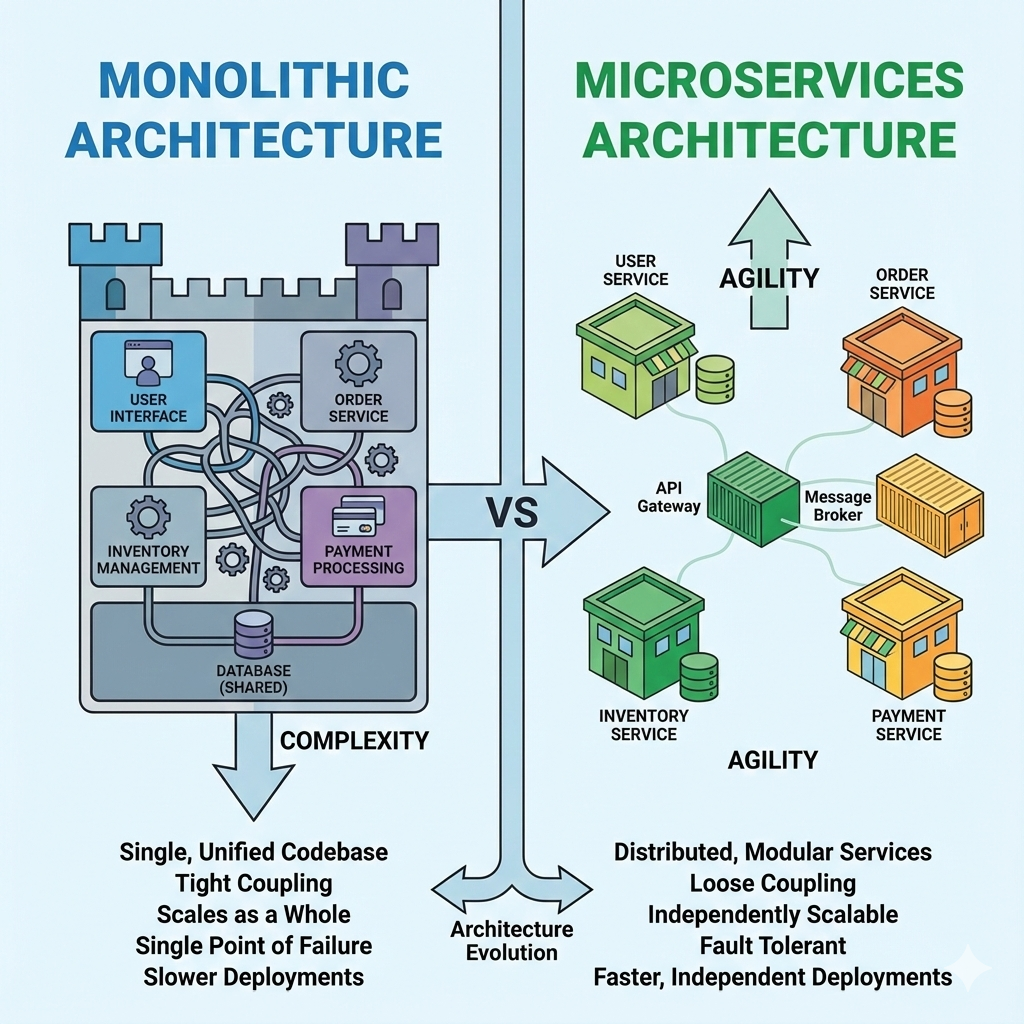
A monolith is a single, unified application where all components—UI, business logic, and data access—are tightly coupled and deployed together.
Characteristics:
- Single codebase
- Single deployment unit
- Shared database
Example:
A traditional e-commerce app where user management, product catalog, orders, and payments all run as one application.
Pros of Monoliths
- Simple to develop and deploy
- Easier debugging and testing
- Lower operational overhead
- Faster initial development
Cons of Monoliths
- Harder to scale individual components
- Slower deployments as system grows
- Tight coupling between features
- One bug can affect the entire system
What Are Microservices?
Microservices architecture breaks an application into small, independent services that communicate over APIs.
Each service:
- Has its own codebase
- Can be deployed independently
- Owns its own data
Example:
Separate services for users, orders, payments, and notifications.
Pros of Microservices
- Independent scaling
- Faster, isolated deployments
- Technology flexibility
- Better fault isolation
Cons of Microservices
- Higher operational complexity
- Network latency and failures
- Complex debugging and monitoring
- Requires strong DevOps practices
Monolith vs Microservices: Key Differences
| Aspect | Monolith | Microservices |
|---|---|---|
| Deployment | Single unit | Independent services |
| Scaling | Whole app | Per service |
| Complexity | Low initially | High from start |
| Failure Impact | Entire app | Isolated services |
| Data | Shared database | Service-owned data |
When to Use a Monolith
Monoliths are ideal when:
- Building an MVP or early-stage product
- Team size is small
- Requirements are evolving
- Simplicity is more important than scale
Best practice:
Start with a well-structured modular monolith.
When to Use Microservices
Microservices make sense when:
- Application has grown large
- Teams are independent and distributed
- Different components scale differently
- High availability is required
Important:
Microservices solve organizational and scaling problems—not early startup problems.
Migrating from Monolith to Microservices
Most systems don’t start with microservices. A common path is:
- Build a monolith
- Identify bottlenecks
- Extract high-impact services (e.g., payments, search)
- Gradually migrate
This approach reduces risk and complexity.
Key Takeaways
- Monoliths are simple and fast to build
- Microservices offer scalability and flexibility at the cost of complexity
- Start simple, scale architecture when needed
- Architecture should match team size and business needs
There is no “one-size-fits-all” solution in system design.
What’s Next?
In the next blog, we’ll explore:
👉 Event-Driven Architecture & Messaging
Learn how systems communicate asynchronously at scale.