As systems grow and move toward microservices, direct synchronous communication becomes a bottleneck.
Event-driven architecture (EDA) helps systems scale by allowing services to communicate asynchronously using events and messages.
In this blog, we’ll cover event-driven architecture, message queues vs event streams, and when to use each.
Synchronous vs Asynchronous Communication
Synchronous Communication
- Client waits for a response
- Tight coupling between services
Example:
Service A calls Service B via HTTP and waits for a response.
Problems at scale:
- Cascading failures
- Increased latency
- Reduced availability
Asynchronous Communication
- Sender does not wait for a response
- Loose coupling between services
Example:
Service A publishes an event; Service B processes it later.
This improves resilience and scalability.
What Is Event-Driven Architecture?
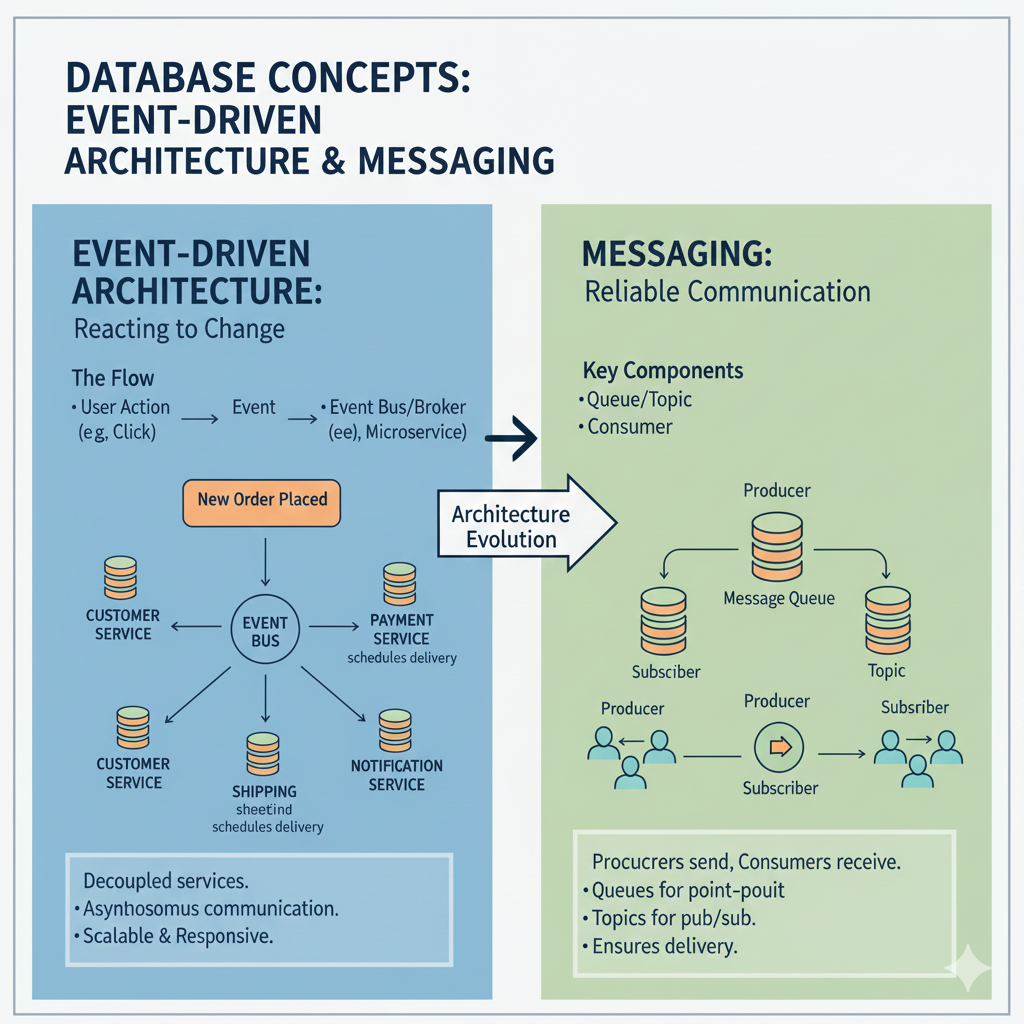
In event-driven architecture, systems communicate by producing and consuming events.
- Event: Something that happened (e.g., “OrderPlaced”)
- Producer: Service that emits events
- Consumer: Service that reacts to events
Services don’t need to know about each other—only about events.
Message Queues vs Event Streams
Message Queues
Message queues deliver messages once to a consumer.
Characteristics:
- Point-to-point communication
- Messages removed after consumption
- Good for task processing
Examples: RabbitMQ, SQS
Use cases:
- Email sending
- Background jobs
- Order processing workflows
Event Streams
Event streams store events as an append-only log.
Characteristics:
- Multiple consumers can read events
- Events are retained for a period
- Consumers track their own offsets
Examples: Kafka, Pulsar
Use cases:
- Activity tracking
- Analytics pipelines
- Real-time data processing
At-Least-Once vs Exactly-Once Delivery
- At-least-once: Message may be delivered more than once
- At-most-once: Message may be lost but never duplicated
- Exactly-once: Message delivered exactly once (hard to guarantee)
Most systems use at-least-once delivery with idempotent consumers.
Idempotency in Messaging
Idempotent consumers can safely process the same message multiple times without side effects.
Example:
Using unique order IDs to avoid duplicate order creation.
Idempotency is critical in distributed systems.
Event-Driven Use Cases
- Notifications and emails
- Order processing
- Inventory updates
- Audit logs
- Real-time analytics
EDA improves system flexibility and fault tolerance.
Challenges of Event-Driven Systems
- Debugging is harder
- Event ordering issues
- Data consistency across services
- Monitoring and observability required
EDA trades simplicity for scalability.
Key Takeaways
- Event-driven systems use asynchronous communication
- Message queues are good for tasks
- Event streams are ideal for data pipelines
- Idempotency is essential
- EDA improves scalability and resilience
Event-driven architecture is foundational for modern distributed systems.
What’s Next?
In the next blog, we’ll explore:
👉 Fault Tolerance, Failover & High Availability
Learn how systems survive failures.