Understanding how distributed systems behave is critical for building reliable software.
Two key concepts that guide system behavior are the CAP Theorem and ACID/BASE properties.
This blog explains these concepts simply, so you can apply them in real-world designs and interviews.
CAP Theorem
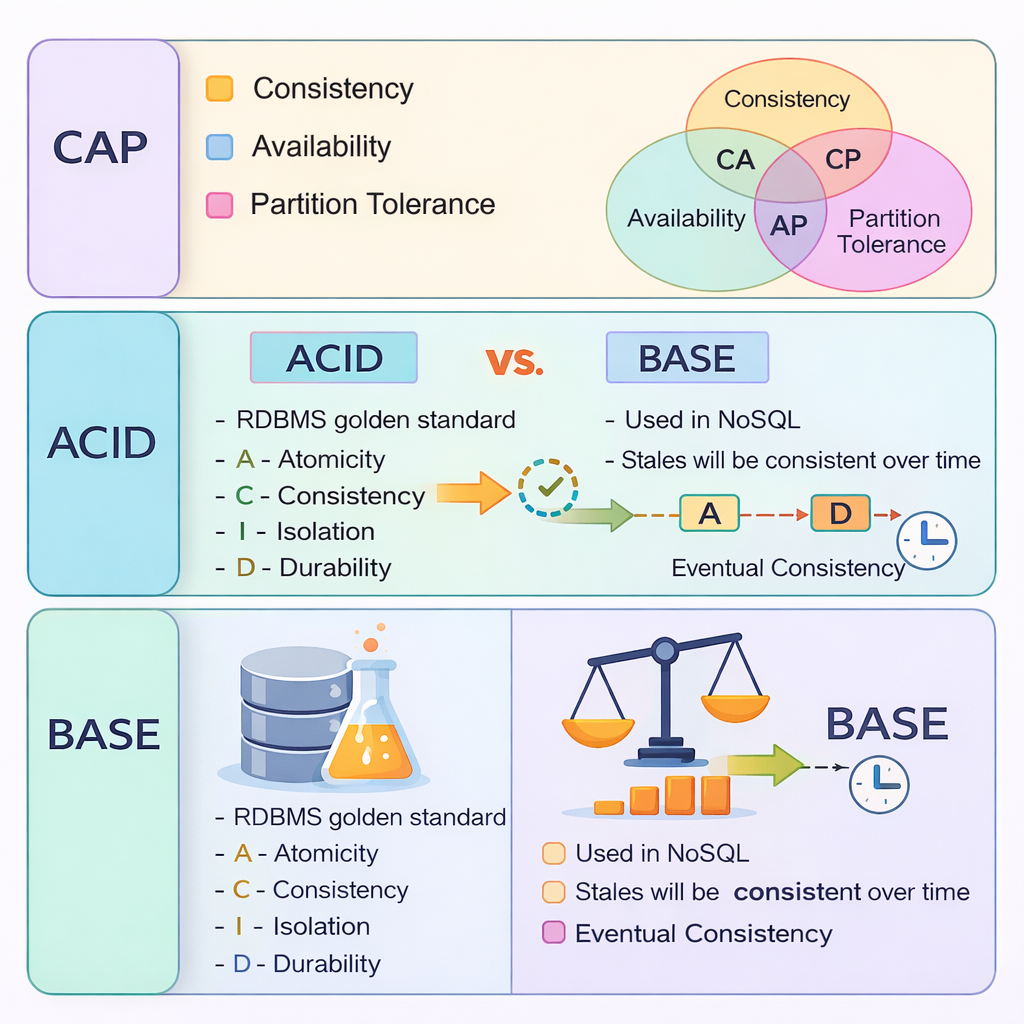
CAP stands for Consistency, Availability, and Partition Tolerance.
Key Points:
- Consistency (C): All nodes see the same data at the same time.
- Availability (A): Every request receives a response (success or failure).
- Partition Tolerance (P): System continues to operate even if network failures occur between nodes.
Rule: In a distributed system, you can achieve at most two of the three simultaneously.
Example:
- A system that prioritizes consistency and partition tolerance may reject requests during network splits.
- A system that prioritizes availability and partition tolerance may serve slightly outdated data.
ACID Properties
ACID applies to traditional databases to ensure reliable transactions.
- Atomicity: Entire transaction succeeds or fails.
- Consistency: Database remains in a valid state.
- Isolation: Transactions do not interfere with each other.
- Durability: Committed transactions are permanent.
ACID ensures correctness but may reduce availability in distributed setups.
BASE Principles
BASE is often used in NoSQL / distributed systems.
- Basically Available: System guarantees availability.
- Soft state: Data may not be consistent all the time.
- Eventually consistent: Data will become consistent eventually.
BASE trades strict consistency for better scalability and availability.
ACID vs BASE
| Feature | ACID | BASE |
|---|---|---|
| Consistency | Strong | Eventual |
| Availability | Medium | High |
| Latency | Can be higher | Lower |
| Use Case | OLTP | Large-scale distributed apps |
Why This Matters in System Design
- CAP helps you decide what trade-offs are acceptable.
- ACID/BASE influences database choice and transaction handling.
- Real systems balance consistency, availability, and partition tolerance based on requirements.
Key Takeaways
- Distributed systems cannot have everything — choose trade-offs wisely.
- ACID ensures strong consistency; BASE favors availability and scalability.
- Understanding these principles helps you design resilient and efficient systems.
What’s Next?
In the next blog, we’ll cover:
👉 Traffic Management & APIs
You’ll learn about load balancers, reverse proxies, API gateways, and rate limiting strategies.