Large Language Models (LLMs) are incredibly powerful — but also unpredictable. Two identical prompts can produce different responses. Slight wording changes can drastically affect output quality. This makes one skill absolutely critical for anyone building with AI:
Prompt Engineering.
Prompt engineering is the discipline of designing inputs that guide AI models toward reliable, safe, and high-quality outputs. It’s the difference between a fun demo and a production-ready AI system.
In this blog, we’ll go beyond basic tips and explore how prompt engineering works in real-world AI systems.
Why Prompt Engineering Matters
LLMs are not deterministic programs. They are probabilistic systems trained on massive datasets. That means:
- Outputs vary with wording
- Context changes behavior
- Instructions compete with user inputs
- Ambiguity causes hallucinations
Without structured prompting:
- AI becomes unreliable
- Hallucinations increase
- UX becomes inconsistent
- Guardrails break
Prompt engineering introduces control, predictability, and structure into AI workflows.
What Is a Prompt?
A prompt is more than a question. It’s a structured instruction that defines:
- Task
- Context
- Constraints
- Output format
- Tone
A good prompt is closer to a mini program than a sentence.
Anatomy of a Production Prompt
Most real-world prompts contain multiple components.
1. System Instruction
Defines model behavior and personality.
Example
You are a senior backend architect who explains concepts clearly and concisely.
This sets tone, expertise, and response style.
2. Task Definition
What exactly should the model do?
Bad:
Explain caching
Better:
Explain distributed caching to a mid-level backend engineer in under 200 words.
Specificity improves output quality dramatically.
3. Context Injection
Provide relevant data or background.
Used heavily in RAG systems.
Context:
Redis is an in-memory data store used for caching and messaging.
More context = less hallucination.
4. Constraints
Bound the model’s behavior.
Examples:
- Word limits
- No speculation
- Use bullet points
- Avoid marketing tone
Constraints reduce variability.
5. Output Format
For production systems, formatting is critical.
Example
Return output in JSON:
{
  "summary": "",
  "pros": [],
  "cons": []
}
Structured outputs make AI integration reliable.
From Prompts to Prompt Templates
In real systems, prompts are rarely static.
They are templates with dynamic variables:
You are a helpful AI assistant.User question: {query}
User role: {user_type}
Tone: {tone}Answer clearly and concisely.
Templates allow:
- Personalization
- A/B testing
- Localization
- Feature experimentation
This is how modern AI products scale.
Core Prompt Engineering Techniques
Let’s explore practical techniques used in production.
1. Role Prompting
Assign a role to guide expertise and tone.
Example
You are a cloud cost optimization expert.
Why it works:
- Activates relevant training distributions
- Improves reasoning depth
- Reduces generic answers
2. Few-Shot Prompting
Provide examples of desired outputs.
Example
Classify sentiment:Input: I love this product
Output: PositiveInput: This is terrible
Output: NegativeInput: {user_input}
Output:
This teaches the model patterns without fine-tuning.
Few-shot prompting is extremely powerful for:
- Classification
- Formatting
- Style control
3. Chain-of-Thought Prompting
Encourage step-by-step reasoning.
Think step by step before answering.
This improves:
- Logical reasoning
- Math tasks
- Complex problem-solving
However, in production:
- Often hidden from users
- Used internally for quality
4. Instruction Decomposition
Break complex tasks into smaller steps.
Instead of:
Analyze this startup and give investment advice.
Use:
1. Summarize the business model
2. Identify strengths
3. Identify risks
4. Provide balanced recommendation
This reduces hallucinations and improves clarity.
5. Output Structuring
Force structured outputs for reliability.
Example
Return response in JSON only. No explanation outside JSON.
This enables:
- Automation
- API integration
- Validation layers
6. Temperature and Sampling Control
Prompting isn’t just text — parameters matter.
Key controls:
- Temperature
- Low → deterministic
- High → creative
- Top-p
- Controls diversity
Production tip:
- Use low temperature for APIs
- Higher for creative writing
Prompt Engineering for Different Use Cases
Different applications require different strategies.
1. Chatbots
Focus:
- Tone consistency
- Safety
- Context retention
Use:
- Strong system prompts
- Memory summarization
- Guardrails
2. RAG Systems
Focus:
- Grounding in retrieved knowledge
- Reducing hallucinations
Best practices:
- Clear separation of context vs instruction
- Citations in output
- Context window optimization
3. AI Agents
Agents require:
- Tool instructions
- Decision boundaries
- Failure handling prompts
Example:
If unsure, ask clarification questions instead of guessing.
This dramatically improves agent reliability.
4. Structured Data Extraction
Key goals:
- Precision
- Deterministic outputs
Use:
- Strict schemas
- Few-shot examples
- Validation layers
Common Prompt Engineering Mistakes
Let’s look at pitfalls seen in real systems.
1. Vague Instructions
Ambiguous prompts cause hallucinations.
Bad:
Tell me about databases
2. Overloading Context
Too much irrelevant context reduces accuracy.
Prompt engineering is also about context pruning.
3. Mixing Instructions with User Input
Separating system instructions from user content is critical for safety.
This prevents prompt injection attacks.
4. Ignoring Output Validation
Even great prompts fail sometimes.
Always validate outputs in production.
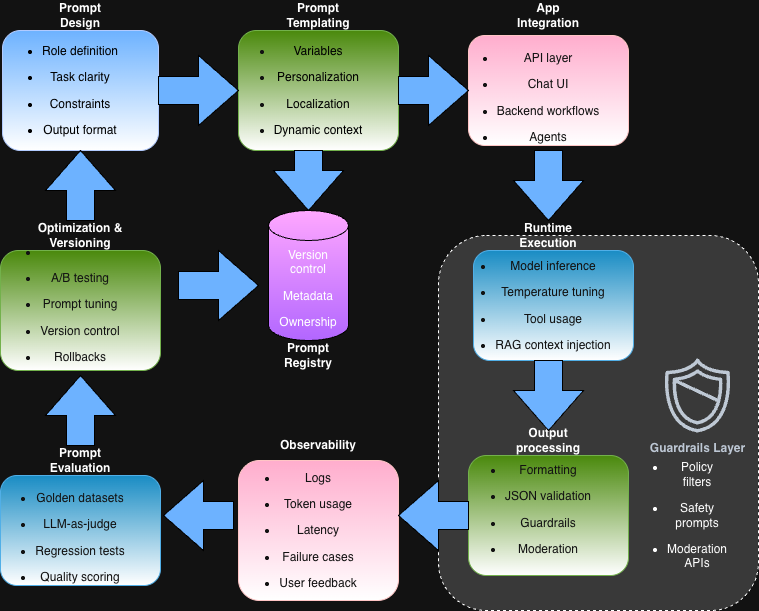
Prompt Versioning and Management
As AI systems mature, prompts become assets.
Best practices:
- Store prompts in Git
- Use version tags
- Track prompt performance
- A/B test prompt variants
Some teams even build:
- Prompt registries
- Prompt analytics dashboards
This elevates prompt engineering to an engineering discipline.
Prompt Testing Strategies
Testing prompts is different from traditional testing.
You can:
- Use golden datasets
- Track regression cases
- Run batch prompt evaluations
- Score outputs with LLM-as-a-judge
This ensures prompt changes don’t silently degrade quality.
Guardrails and Safety Prompting
Prompt engineering is a core layer of AI safety.
Examples:
If the request involves illegal activity, refuse politely.
If unsure, respond with "I don't have enough information."
These soft constraints work alongside:
- Moderation models
- Policy filters
- Output validators
Real-World Example: AI Code Assistant
Let’s say you’re building an AI coding assistant.
A production prompt might include:
- Role: Senior software engineer
- Context: User’s repo structure
- Constraints: Follow project style guide
- Output: Code only, no explanation
- Safety: Avoid insecure patterns
Without structured prompting, outputs become inconsistent and unsafe.
The Future of Prompt Engineering
Prompt engineering is evolving rapidly.
Emerging trends:
- Prompt compilers
- Structured prompting languages
- Automatic prompt optimization
- Tool-aware prompting
- Retrieval-aware prompting
Eventually, prompts may look more like programs than text.
Key Takeaways
- Prompt engineering brings reliability to AI systems
- Structured prompts outperform natural prompts
- Templates and versioning are essential for scale
- Guardrails and validation are non-negotiable
- Prompt engineering is becoming a core AI engineering skill
As AI systems mature, prompt engineering will evolve from an art into a formal discipline.
What’s Next?
Now that you know how to control LLM behavior through prompts, the next step is understanding how AI systems ground themselves in real knowledge.
In the next blog, we’ll explore:
RAG Architecture — How AI Systems Use External Knowledge
This is where AI systems move from generic intelligence to domain expertise.