Adaptive Bitrate Streaming (ABR) – Deep Dive
Traditional video streaming attempted to deliver a single video file at a fixed bitrate. This approach failed badly in real-world conditions where network bandwidth fluctuates constantly — especially on mobile networks. Adaptive Bitrate Streaming (ABR) solves this problem by continuously adjusting video quality based on real-time network conditions and device capabilities.
At its core, ABR breaks a video into small time-based chunks (segments), typically 2–6 seconds long. Each chunk is encoded at multiple bitrates and resolutions (for example, 240p, 360p, 720p, 1080p). Instead of downloading the entire video at once, the client requests these chunks one at a time, dynamically choosing the best quality it can safely play.
Why ABR Is Necessary at Scale
In a large-scale streaming system:
- Users have different devices (phones, TVs, laptops)
- Network conditions vary every second
- Peak traffic causes temporary congestion
- A single user’s bandwidth can change mid-playback
ABR ensures that:
- Playback starts quickly (low initial bitrate)
- Video does not stall during bandwidth drops
- Quality automatically improves when bandwidth allows
This directly improves user retention, which is critical for video platforms.
How ABR Works Internally
Step 1: Multi-Bitrate Encoding
When a video is uploaded, the processing pipeline transcodes it into multiple renditions:
| Resolution | Bitrate |
|---|---|
| 240p | 300 Kbps |
| 360p | 700 Kbps |
| 720p | 2.5 Mbps |
| 1080p | 5 Mbps |
Each rendition is segmented into small chunks:
video_720p_chunk_001.ts
video_720p_chunk_002.ts
This allows the client to switch quality seamlessly between chunks.
Step 2: Manifest / Playlist Generation
A manifest file (also called a playlist) describes:
- Available resolutions
- Bitrates
- Chunk URLs
- Codec information
Examples:
- HLS →
.m3u8 - MPEG-DASH →
.mpd
The manifest is lightweight and fetched first by the client.
Step 3: Client-Side Adaptation Logic
The client player continuously monitors:
- Download speed
- Buffer health
- CPU capability
- Screen resolution
Based on this data, it decides:
- Which chunk to download next
- At what bitrate
If bandwidth drops, the client requests a lower-quality chunk.
If bandwidth improves, it upgrades quality gradually.
This logic lives entirely on the client, reducing server complexity.
Why Chunking Is a Critical Design Choice
Chunking enables:
- Fine-grained adaptation
- Better CDN caching
- Faster recovery from packet loss
- Parallel downloads in some players
Without chunking, adaptive streaming would be impossible.
Popular ABR Protocols
HLS (HTTP Live Streaming)
- Developed by Apple
- Widely supported across devices
- Uses
.m3u8playlists
MPEG-DASH
- Open standard
- Codec-agnostic
- Popular in Android and Smart TVs
Modern systems often support both, serving the appropriate format based on client capabilities.
Scalability Impact of ABR
ABR dramatically improves scalability by:
- Reducing rebuffering (fewer retries)
- Shifting adaptation logic to clients
- Allowing CDN-friendly caching
- Minimizing bandwidth waste
At scale, ABR is not an optimization — it is mandatory.
Content Delivery Network (CDN) & Edge Caching – Deep Dive
Serving video content directly from origin servers does not scale. Video streaming is read-heavy, bandwidth-intensive, and geographically distributed. A Content Delivery Network (CDN) solves this by moving content closer to users.
A CDN consists of thousands of edge servers distributed across regions. These servers cache video chunks and serve them directly to nearby users.
Why CDN Is Essential for Video Streaming
Without a CDN:
- High latency for distant users
- Origin servers overloaded
- Massive bandwidth costs
- Poor playback experience
With a CDN:
- Faster startup times
- Reduced buffering
- Lower origin load
- Better global scalability
For video platforms, CDN is not optional.
How CDN Works Internally
Step 1: DNS-Based Routing
When a client requests a video chunk:
- DNS routes the request to the nearest edge location
- The edge server checks its cache
This routing happens transparently without client awareness.
Step 2: Edge Cache Lookup
- If the chunk exists in cache → Cache Hit
- If not → Cache Miss
On cache miss:
- Edge fetches chunk from origin storage
- Stores it locally
- Serves it to the client
Subsequent users benefit from the cached version.
Step 3: Cache Eviction & TTL
Because storage is limited:
- Chunks have TTL (Time to Live)
- Least Recently Used (LRU) eviction
- Popular videos remain cached longer
Trending videos naturally stay hot in edge caches.
CDN + ABR: A Perfect Match
Chunked ABR streaming aligns perfectly with CDN architecture:
- Small, immutable files
- High cache hit ratio
- Independent chunk requests
- No session affinity required
This makes CDN caching extremely efficient.
Origin Storage vs Edge Storage
| Layer | Responsibility |
|---|---|
| Origin (S3/GCS) | Durable storage |
| CDN Edge | Low latency delivery |
| Client | Adaptive playback |
Only a small percentage of traffic ever reaches origin.
Popular CDN Providers
- Akamai
- Cloudflare
- AWS CloudFront
- Fastly
- Google Cloud CDN
Large platforms often use multi-CDN strategies to:
- Avoid vendor lock-in
- Improve resilience
- Optimize cost
Scalability & Traffic Justification
Assume:
- 1 million concurrent viewers
- Each requesting 2-second chunks
- Average bitrate 3 Mbps
Without CDN:
- Origin bandwidth ≈ 3 Tbps (unsustainable)
With CDN:
- Origin bandwidth < 5%
- Edge absorbs majority traffic
- Linear scalability with user growth
This makes CDN the primary scalability layer for video systems.
Failure Handling & Resilience
If an edge fails:
- DNS routes traffic to nearest healthy edge
- Client retries automatically
- Playback quality may reduce but continues
This ensures graceful degradation instead of failure.
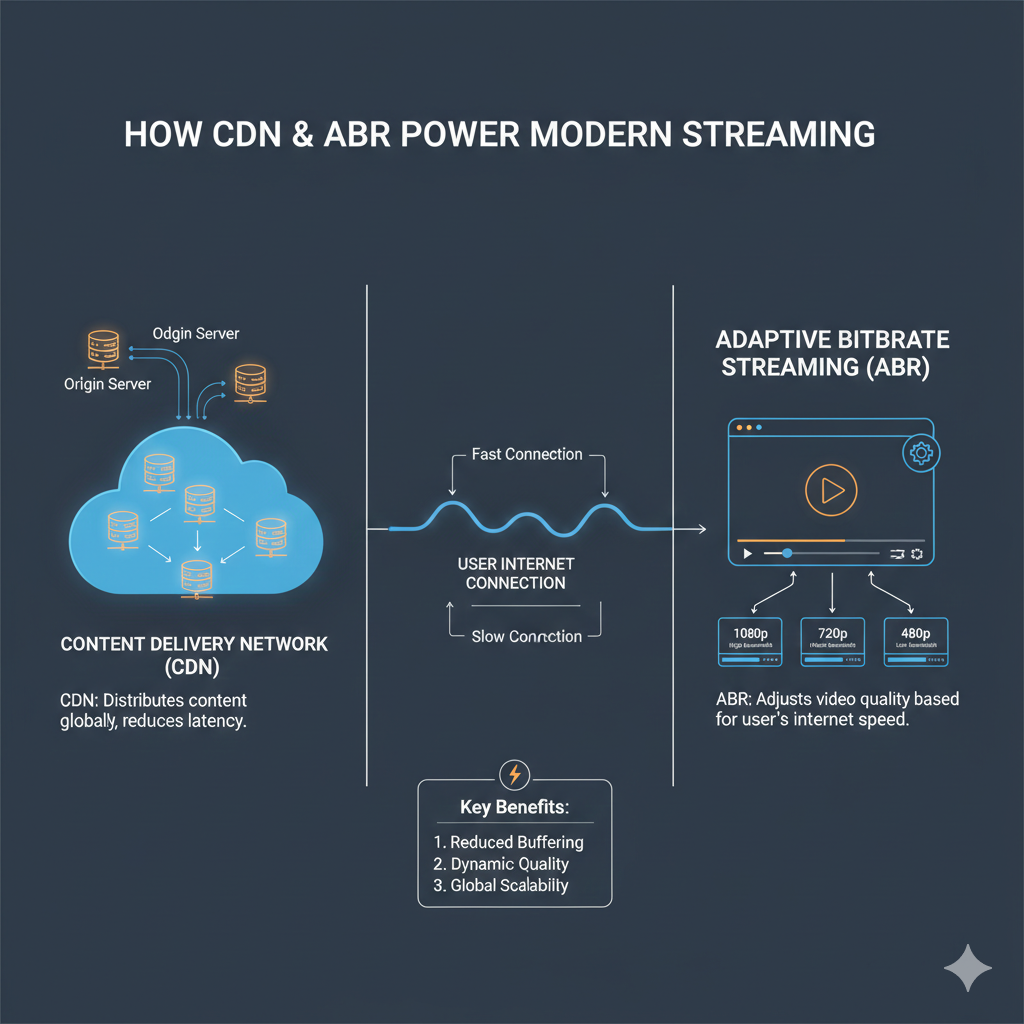
Why CDN & ABR Together Define Modern Streaming
ABR optimizes what quality to serve
CDN optimizes where to serve from
Together, they:
- Minimize latency
- Maximize availability
- Enable global scale
- Control bandwidth cost
Every production video platform relies on this combination.